Rethinking New Year’s Resolutions: A Values Based Approach to Lasting Change

The onset of January often feels a bit unsettling for many of us. Perhaps a little shell shocked at the fleeting nature of the holidays, and of 2025 as a whole. Was it not just 2020 and the year of the pandemic!?
As reliably as the new year arrives, a surge of invitations appear asking us to reflect, reset and reveal a improved version of you. If your social media feed is anything like mine, it’s crammed with the stuff. Capitalising on the burst of motivation following the holiday season.
Do you end up feeling defeated by New Year’s Resolutions that you set? If so, then this blog is for you. I will outline an evidence-based approach to meaningful behaviour change based on principles of Acceptance & Commitment Therapy (ACT). Instead of relying solely on goals, we will also focus on values and what truly matters to you as the driver for lasting change. Uncovering how you want to be rather than what you want to have. One that continues to be relevant whether it’s January or June.
Why Set New Year’s Resolutions?
The beginning of new year offers a concrete turning point that prompts self-reflection for many. Setting New Year’s resolutions often also stems from a deeply ingrained pursuit of happiness. The idea that if we just do this or that then we will finally, eventually, at some point make it. Become complete, and happy all, if not most of the time. We tend to be motivated by short term needs, desires and preferences. We also know that motivation is highest when we experience pain or discomfort. And it’s true that many of us may feel somewhat uncomfortable having falling off the bandwagon with our healthy habits over the last month.
Common Pitfalls of New Year’s Resolutions
I’m sure we can all relate to a fallen New Year’s Resolution. One that dies as quick as it commenced. Or one that lasted a short while, but not a long while. You may be surprised to learn that the reason this happens is often not to do with motivation or knowledge. Below are common traps that get in the way.
Outcome Focussed - Emphasis on what you are setting out to do while neglecting why you are doing it.
Hoping to Feel Differently - Goals/resolutions sneakily disguised as emotional goals.
Misalignment -Goals that aren’t really yours rather, they are based on what society, culture, friends or family say we should be doing.
All or Nothing /Perfectionism - do it 100% or don’t do it at all, throw the towel in after a one miss.
Unrealistic Expectations - Multiple goals across several life areas.
Not Specific - Lacking in clarity - what exactly is it you want to do?
Burnout & Balance - Not checking in with what energy is available to you.
We know that changing behaviour is complex and many theories and models out there attempt to explain it. There is a general consensus that knowledge of what we should be doing is simply not enough to create lasting change. So, if on the 6th of January you, are already on the rapid downward trajectory after setting your resolution/s, know that there are many good reasons why, and you are most definitely not alone. I will go on to explain some of the above reasons in more detail below.
Emotional Versus Behavioural Goals
At the core, humans are motivated to feel pleasure and to avoid discomfort. We often find underlying goals or resolutions, is the quiet drive to feel more of something that we like, or less of something that we don’t like. Sometimes our behaviour is driven by the need to fix, problem solve, get rid of, shut down, fight or suppress certain emotions like anxiety, guilt or anger. Some examples are listed below:
If I get this job then I’ll be happy
I’ll achieve more so I don’t feel like a failure
If I exercise then I will feel less guilty -
I’ll exercise so I feel more confident about my body
I’ll achieve more so I don’t feel like a failure
I’ll be more social so I don’t feel lonely
I’ll avoid the party so I don’t feel anxious
When Feeling Happy is the Goal
While happiness feels good, and it is completely natural to want to feel more of it, when it becomes the ultimate goal then we are likely to run into problems. This is hard because we live in a society that fuels a myth of happiness - If only we are happy then we will be okay, and we will feel good. One that encourages a relentless quest toward success, achievement and accomplishment. But has anyone actually ever got there? Are they finally happy? In fact, holding on tightly to the notion of happiness is likely to fast-track us to unhappiness, in a cruel twist of irony.
When working with clients, it’s often their attempts to feel less of something that they don’t like and more of something they like that exacerbate suffering. So rather than suffering itself, it becomes the attempts at managing suffering that often escalates pain and fuels disconnect from the lives we truly want to live.
A bit like the weather, our inner world is constantly changing. Sunshine, rain, snow, wind and hail can all show up in the same day, particularly if you live in the UK or Scandinavia. Seeking constant sunshine if you live there is a bit like expecting blue skies year-round in these places – unrealistic and sabotaging.
Fluctuating Emotions are Normal
There is a widespread belief that if you are not happy most of the time, then you are doing something wrong. This is not true. Experiencing difficult emotions is a natural part of life. It’s human to feel the full spectrum of emotion – some pleasant and some unpleasant. Have you ever said I’ll do it when I feel like it? I know I have. This is another trap because what if we never actually feel like it? Research shows us that fulfilment and contentment is driven less by emotions and more by our actions or behaviour. So in short, life satisfaction does not come from chasing pleasant emotions rather it is about making commitments and actions that align with our values, regardless of what we are feeling internally.
We know that as soon as we start to care about something then we become vulnerable to suffering. That’s normal. When we acknowledge and accept that we will experience discomfort, then we open up to opportunity to live our life even in the presence of suffering. This often leads to a strange juxtaposition of feelings where opposing feelings co-exist. Can you think of other times when this happens? Some examples are listed below.
Relationships can be joyful AND stressful.
Work can be satisfying AND stressful.
Parenting can be frustrating AND joyful.
Values versus Goals
Taking action and making choices based on what truly matters to you is more likely to lead to a meaningful and fulfilling life. Values ask the question of WHY rather that WHAT – why are you doing what you are doing?
Goals are the destination - outcome focussed, achievable or not achievable, success or failure.
Values are the journey - act as a compass guiding you in life, ongoing and process focussed. Never fully complete.
Lighthouses were built to warn ships of dangerous coastlines and guide them safely to harbour. Think of your values a bit like a lighthouse – even in the stormiest weathers - a clear beacon that helps you orientate and find direction. Lighthouses don’t remove the storms but they help with navigation until it passes.
Why Focus on Values?
Research consistently shows that living in line with personal values is associated with:
Greater well-being and life satisfaction
Reduce rates of anxiety and depression
Improved physical health outcomes
Longer lasting change
Identifying Values
Values are personal. They are not about social conformity, family expectation or prescribed cultural “shoulds”. Living a life according to someone else’s values rarely lead to contentment. Have a go answering the questions below. I appreciate they are big questions with no easy answers:
What truly matters to me?
What gives my life meaning?
What do I stand for?
If I was to look back at the end of my life – what would I want to see?
What kind of person do I want to be – even when life is hard?
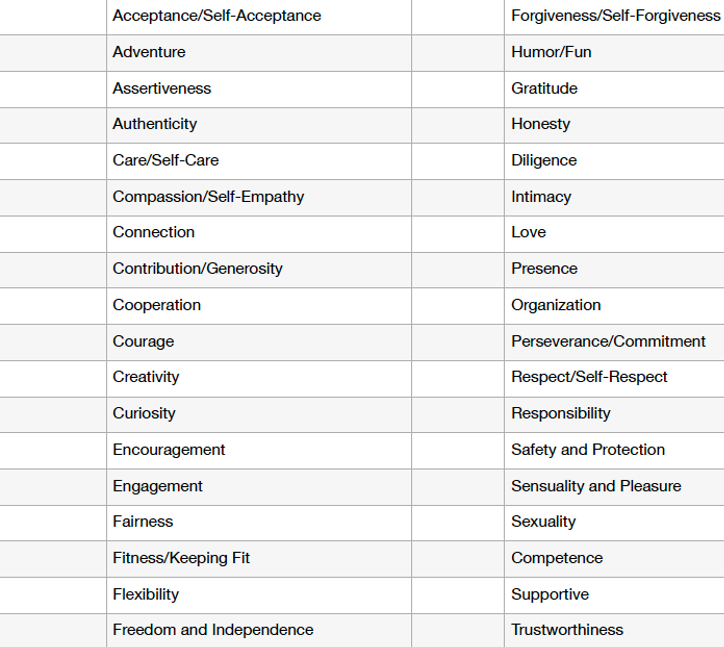
Values Exercise:
1. Tick what matters to you and consider how it is you want that value to show up in your life.
2. Rate the importance of each area (3-very important, 2-somewhat important, 1- not so important)
3. Rate your current level of satisfaction with it
Values Based Action
Once you know your WHY you can identifying the WHAT. Commitments to action and behaviour are how values come to life and show up in daily living. What one small commitment can you make this week to move closer to a chosen value?
Link the action to your values
Do not rely on emotions/ wait for emotions before action
Start small
Flexible
Specific
Present focus
Lead with compassion
Monitor Energy Levels
The Path of Progress
Progress is rarely linear and it may take a few steps forward and a few steps back. It is completely normal to drift from your values, especially during difficult times – no one is living their lives 100% values orientated. Try to recognise, with compassion, the drift and take tiny intentional steps to return to your values. Something is better than nothing. Some helpful questions to ask if you feel stuck:
What pulled me away from my values?
What was I trying to get rid of?
What was I trying to get more of?
What would a values based action look like right now?
Am I moving toward or away from the person I want to be, and the life I want to lead
A meaningful and fulfilling life begins with knowing what truly matters to you. When behaviour is guided by our values rather than our emotions, change becomes more sustainable and life becomes richer, even in the presence of difficult emotions. If you would like to discover more about values or uncovering your own blueprint for a good life, you may find it helpful to read more about ACT or reach out to an ACT therapist today.